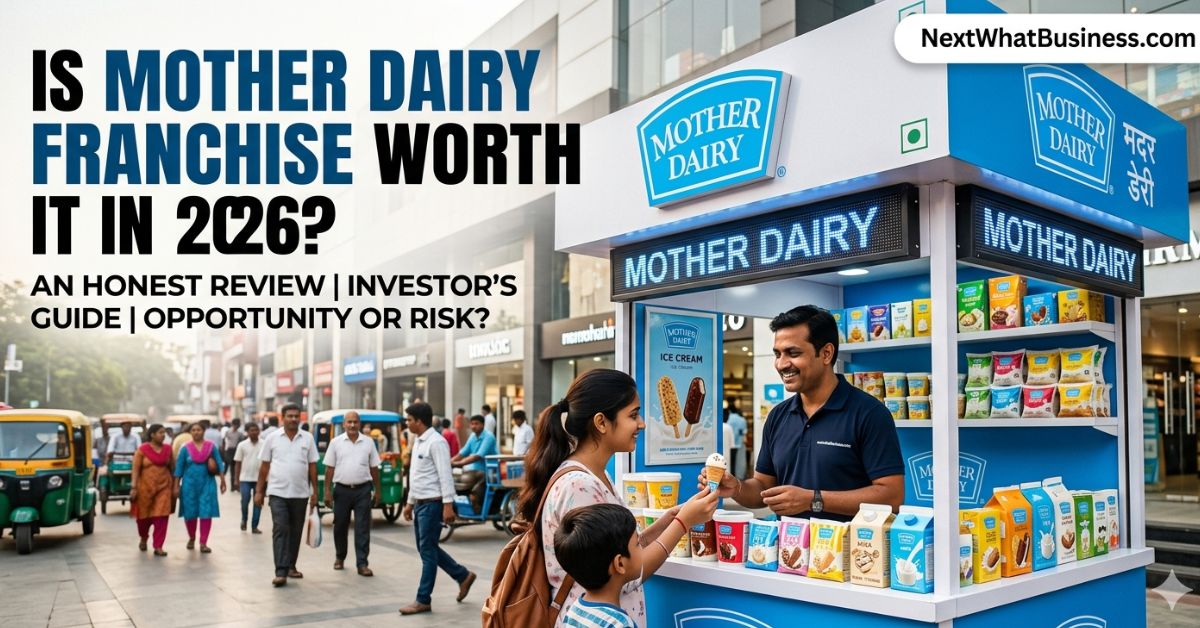
The standard information available online about the Mother Dairy franchise covers NDDB backing, government stability, and a 30% ROI. What it does not tell you is that fresh fruits and vegetables spoil in 1–4 days, that you are the sole supplier’s captive — meaning no backup if stock is delayed — and that Blinkit, Zepto, and BigBasket are aggressively competing for the same daily grocery customer you are counting on.
This article gives you the complete picture: the genuine strengths, the real profit numbers after costs, the challenges nobody mentions, and an honest verdict on whether this franchise suits your situation in 2026.
Already decided to apply? Skip directly to our Mother Dairy franchise listing → for the full cost tables, format breakdown, and application steps.
What Is the Mother Dairy Franchise
Mother Dairy was established in 1974 as a wholly-owned subsidiary of the National Dairy Development Board (NDDB) — a government body. This is significant: unlike most franchises, Mother Dairy is not a private corporate chain chasing quarterly profits. It is a mission-driven institution whose stated purpose is delivering affordable nutrition to consumers while giving fair returns to farmers.
That background shapes the franchise experience in important ways. The brand is deeply trusted in North and East India. Supply chains are professionally managed. And the product range is genuinely wide — milk, dairy products, ice cream, frozen foods, edible oils (Dhara), and fresh produce (Safal) — giving franchisees multiple revenue streams under one roof.
The company currently operates through 3,500+ retail touchpoints and posted a group turnover of approximately ₹17,000 crore in FY2024-25. It is not a small or struggling operation, which matters when you are depending on their supply chain for your daily stock.
Mother Dairy Franchise Cost — All Four Formats
Mother Dairy offers four primary franchise formats with meaningfully different investment levels, space requirements, and income potential.
Format | Space | Key Products | Total Investment | Best For |
|---|---|---|---|---|
Milk Booth (Standard) | 80–150 sq ft | Liquid milk, curd, lassi, butter, flavoured milk | ₹50,000–₹1.5 lakhs | Residential areas, low capital investors, first-time operators |
Milk Booth (Full-Range) | 150–250 sq ft | All dairy + packaged foods + ice cream + Dhara oils | ₹1.5–₹3 lakhs | Mid-density residential, market-adjacent locations |
Safal Outlet (Fruits & Vegetables) | 200–500 sq ft | Fresh produce + dairy + frozen + pulses + edible oils | ₹3–₹7 lakhs | High-footfall residential markets; Tier-2 city commercial streets |
Mother Dairy Retail Store (Full Format) | 500–1,000 sq ft | Complete range — dairy, Safal, Dhara, Pro products, frozen, ice cream, grocery | ₹5–₹15 lakhs | Commercial markets, transport hubs, housing society catchments with 500+ families |
Detailed Cost Breakdown — Safal Outlet (Most Common Format)
Cost Head | Amount |
|---|---|
Franchise/dealership application (no fee — verify directly) | ₹0 |
Refundable security deposit | ₹50,000–₹1 lakh |
Interior fit-out — display units, vegetable racks, and flooring | ₹1–₹2 lakhs |
Refrigeration — cold display units, chest freezers for dairy and frozen | ₹1–₹2.5 lakhs |
Weighing scale, billing system, CCTV | ₹20,000–₹50,000 |
Branding and signage | ₹20,000–₹40,000 |
Working capital — initial inventory payment | ₹50,000–₹1 lakh |
Licensing — FSSAI, trade licence, fire safety | ₹15,000–₹30,000 |
Total — Safal outlet | ₹3.55–₹8.2 lakhs |
The Ex-Servicemen Programme — Confirmed Terms
Mother Dairy has a formally structured franchise programme for ex-servicemen (JCOs and Other Ranks) through the DGR (Directorate General Resettlement) and AWPO. The confirmed terms as per the official DGR and Mother Dairy documentation are:
- Milk Booth: Assured income of ₹15,000/month OR 30–35 paisa per litre of milk sold — whichever is more; 5% commission on other dairy products
- Safal Outlet: 9% commission on fruits and vegetables; 3% on dals and pulses
- Security deposit: ₹1,00,000 refundable
- Working capital: ₹50,000
- Training: Free 2-week pre-allotment training
- Agreement term: 2 years (renewable)
- Available in: Delhi-NCR and satellite cities — Gurgaon, Ghaziabad, Noida/Greater Noida, Faridabad (through DGR route)
If you or a family member is an eligible ex-serviceman, this is the most clearly structured, lowest-risk entry pathway into the Mother Dairy franchise system.
The Hidden Costs Nobody Talks About
1. Perishable Wastage — The Safal Franchise’s Biggest Risk
Fresh fruits and vegetables have a shelf life of 1–4 days. If you overstock and demand drops — due to rain, a local competitor’s sale, or simply misjudging that day’s volume — you absorb the loss entirely. Experienced Safal franchisees report that wastage can account for 5–12% of procurement cost until you have mastered daily demand forecasting. This is a skill that takes months to develop and can significantly erode margins in the early months of operation.
2. Price Volatility on Produce
Unlike dairy products with fixed MRPs, fresh produce prices fluctuate based on season, weather, and wholesale market conditions. When tomatoes or onions spike at the wholesale level, your margins compress. When local vendors undercut you during oversupply periods, footfall can drop sharply. This is a category-level risk that is structurally unavoidable — and significantly different from operating an Amul dairy outlet with fixed retail prices.
3. Single Supplier Dependency
Mother Dairy is your sole product supplier. There is no alternative distributor you can fall back on. If there is a supply delay, a regional stockout, or a logistics disruption, your shelves go empty, and customers go elsewhere. Many franchisees report that even a single day of stock absence in milk — a daily-purchase item — can permanently shift a customer’s habit. This risk is real and worth accounting for in your planning.
4. Quick Commerce Competition
This is the most significant new threat facing Mother Dairy Safal franchisees in 2026. Blinkit, Zepto, Swiggy Instamart, and BigBasket now deliver milk, curd, paneer, fruits, and vegetables to customers’ doors in 10–30 minutes at competitive prices. In urban areas, this has measurably reduced walk-in footfall to neighbourhood dairy and produce outlets. A Safal franchisee in a metro area is now competing not just against local vendors but against well-funded, discount-driven delivery apps that did not exist at scale five years ago. This is a structural challenge, not a temporary one.
5. High Operational Intensity
Fresh produce arrives in the early morning — typically before 6 am at Safal outlets. Display, sorting, and quality checks happen before the store opens. Unsold produce at day-end must be assessed and either discounted or written off. This is a 7-day-a-week operation with no natural rest days. If you plan to step away for even a day, you need a trained, reliable person to manage quality and inventory decisions in your absence. This is operationally demanding in a way that a packaged-goods retail outlet simply is not.
Mother Dairy Franchise Rating — Our Verdict at a Glance
Parameter | Rating | Why |
|---|---|---|
Brand strength | ⭐⭐⭐⭐ 4/5 | Dominant in North India and major metros; weaker recognition in South and West |
Investment requirement | ⭐⭐⭐ 3/5 | Higher entry cost than Amul — ₹5–15 lakhs, depending on format |
Profit potential | ⭐⭐⭐ 3/5 | Solid with the right location and product mix; margins are modest on core dairy |
Operational complexity | ⭐⭐ 2/5 (risk) | Perishable inventory management is genuinely demanding — a daily active effort is required |
Competition resilience | ⭐⭐⭐ 3/5 | Quick commerce apps are a real and growing threat to the daily grocery model |
Support from franchisor | ⭐⭐⭐⭐ 4/5 | Strong supply chain, training, and operational support — better than most franchises |
Overall verdict | ⭐⭐⭐⭐ 4/5 | A genuinely solid franchise — but only for hands-on operators in the right geography |
The Profit Reality — What Do Franchisees Actually Earn?
Promotional material for the Mother Dairy franchise often cites 30% ROI and ₹2–6 lakh monthly revenues. These are achievable figures — but they come with conditions that are not always made clear upfront. Here is what the actual monthly economics look like across formats.
Mother Dairy Milk Booth — Realistic Monthly P&L
Item | Conservative Location | Good Location |
|---|---|---|
Monthly sales turnover | ₹3–5 lakhs | ₹6–10 lakhs |
Commission / gross margin (3.5–5%) | ₹10,500–₹25,000 | ₹21,000–₹50,000 |
Rent (location dependent) | ₹5,000–₹10,000 | ₹10,000–₹25,000 |
Electricity (refrigeration) | ₹3,000–₹5,000 | ₹5,000–₹8,000 |
Staff (1–2 people) | ₹8,000–₹12,000 | ₹10,000–₹15,000 |
Misc and wastage | ₹2,000–₹3,000 | ₹3,000–₹5,000 |
Net monthly profit | ₹(−7,500) to ₹5,000 | ₹25,000–₹45,000 |
Mother Dairy Safal Outlet — Realistic Monthly P&L
Item | Conservative Location | Good Location |
|---|---|---|
Monthly sales turnover | ₹5–8 lakhs | ₹12–18 lakhs |
Gross margin (blended 10–15% on produce, 20–25% on dairy) | ₹55,000–₹1,00,000 | ₹1,40,000–₹2,50,000 |
Rent | ₹15,000–₹25,000 | ₹25,000–₹50,000 |
Electricity | ₹8,000–₹12,000 | ₹12,000–₹18,000 |
Staff (2–3 people) | ₹16,000–₹25,000 | ₹25,000–₹40,000 |
Wastage (perishable produce) | ₹8,000–₹15,000 | ₹15,000–₹25,000 |
Misc | ₹3,000–₹5,000 | ₹5,000–₹8,000 |
Net monthly profit | ₹18,000–₹38,000 | ₹63,000–₹1,09,000 |
Key insight: The Milk Booth format has very thin margins — 3.5–5% commission on milk sales. A booth turning over ₹6 lakhs/month earns only ₹21,000–₹30,000 gross before rent, electricity, and staff. It works as a business only in genuinely high-footfall locations where volume compensates for the low percentage. The Safal outlet has better blended margins meaningfully, but introduces the significant challenge of managing perishable inventory daily.
Who Can Apply — The Geography Question
Mother Dairy’s franchise strength is highly geography-specific. This matters enormously before you apply.
Region | Mother Dairy Franchise Suitability | Reason |
|---|---|---|
Delhi / NCR | ✅ Excellent | Brand’s heartland — extremely strong recognition, established supply chain, loyal customer base |
UP, Haryana, Punjab, Rajasthan | ✅ Very good | Strong distribution presence, well-known brand in North India |
West Bengal, Odisha | ✅ Good | Reasonable penetration — Mishti Doi and cultured products have regional resonance |
Mumbai, Pune | ⚠️ Moderate | Present but competes with Amul and local brands — brand recognition is lower than in North |
Hyderabad, Chennai, Bangalore | ⚠️ Limited | Weaker distribution and brand recognition — Amul and local regional brands dominate |
Tier-2 / Tier-3 outside North India | ❌ Generally not recommended | Supply chain infrastructure may not support reliable restocking outside core regions |
Before applying for a Mother Dairy franchise outside Delhi NCR and major North Indian cities, verify directly with Mother Dairy’s regional office whether they have active wholesale distributors and reliable cold chain infrastructure in your specific location. A franchise without a reliable local supply chain is not a viable business.
Mother Dairy Franchise vs Amul Franchise — Which Is Better?
Parameter | Mother Dairy Franchise | Amul Franchise |
|---|---|---|
Brand recognition | Dominant in North India; limited in South and West | Pan-India — equally strong in all regions |
Entry investment | ₹5–15 lakhs (format dependent) | ₹2–6 lakhs (significantly lower) |
Commission/margin | 3.5–10% on dairy; 10–15% on produce; up to 25% on non-dairy | 2.5–20% on dairy; up to 50% on recipe items (Scooping Parlour) |
Product range | Very wide — dairy + fresh produce + frozen + edible oils + grocery | Wide — dairy + ice cream + recipe items (Scooping Parlour) |
Ice cream/dessert focus | Limited dedicated ice cream formats | Strong — dedicated Scooping Parlour with 50% margins on recipe items |
Fresh produce | Strong — Safal is a dedicated fresh produce brand | Not available |
Operational complexity | High — perishable daily management is essential | Moderate — packaged products have a longer shelf life |
Competition from quick commerce | Higher — core products are daily grocery items | Lower — ice cream and dairy have more impulse-purchase, in-store behaviour |
Geographic coverage | North India and select metros | Pan India with established distribution everywhere |
Best for | North India investors wanting a full grocery + dairy model | Anyone, anywhere in India, wanting a food retail business |
Our verdict: If you are in Delhi NCR or North India and can handle the operational demands of fresh produce, Mother Dairy’s Safal model offers a broader product basket and potentially higher revenue. For everyone else — or for investors who want a simpler daily operation — Amul’s lower investment, pan-India supply chain, and higher ice cream margins make it the more accessible choice.
Who Should Open a Mother Dairy Franchise
- Investors in Delhi NCR and major North Indian cities, where the brand has deep penetration, and the supply chain is reliably established
- Hands-on, daily-active operators who can personally manage or closely supervise perishable inventory — wastage management is not something you can delegate to an untrained staff member
- People who already own or lease suitable ground-floor space in a residential area with genuine daily footfall — owned premises dramatically improve unit economics by eliminating rent
- Investors who want to serve a full daily grocery basket — milk, curd, paneer, butter, fruits, vegetables, frozen foods, and edible oils — and can manage the complexity that comes with it
- Ex-servicemen — Mother Dairy has a dedicated franchise program through AWPO/DGR for armed forces veterans with prioritised allotment, lower deposits, and structured support
Who Should NOT Open a Mother Dairy Franchise
- Investors outside North India and major metros, where Mother Dairy’s supply chain infrastructure may not be strong enough to support reliable daily restocking
- Anyone expecting a semi-passive business. This franchise demands daily physical presence or very close management. Fresh produce arriving at 5–6 am needs inspection, sorting, and display before the store opens. This is not a business you manage remotely
- Investors whose proposed location has strong quick commerce penetration. If your target customers are already habitual Blinkit or Zepto users in a dense urban area, converting them to walk-in buyers is an uphill challenge
- First-time retail operators with no staff management experience — the Safal format, in particular, requires managing staff, daily inventory decisions, and supplier relations simultaneously. It rewards experience
- Anyone who cannot absorb a 24-month break-even period — ROI typically comes in 18–36 months, depending on format and location
Final Verdict — Is the Mother Dairy Franchise Worth It in 2026?
Yes — for the right person in the right location. The Mother Dairy franchise is a genuinely sound business opportunity backed by an institution with five decades of operations, a government mandate, and a product range that covers daily household needs. These are real structural advantages that most private franchises cannot match.
But it is not an easy business. Managing perishable inventory daily, competing with quick commerce apps, and operating in a low-margin commodity category requires a level of operational discipline and local market understanding that not every investor brings.
The franchise rewards hands-on operators in North India with good residential locations. It is not the right choice for passive investors, for those in geographies outside Mother Dairy’s strong distribution network, or for anyone underestimating the daily operational demands of a fresh produce and dairy business.
Go in with a realistic understanding of margins — not just the headline ROI figure. Visit existing Mother Dairy outlets in your area, talk to current franchisees if possible, and verify supply chain reliability in your specific location before signing anything.
Ready to move forward? View our Mother Dairy franchise listing → for the complete cost breakdown, all franchise formats, eligibility criteria, documents required, and direct contact details.
Similar Franchise Opportunities:
Frequently Asked Questions
Is Mother Dairy franchise profitable in small towns?
Potentially — but only in North Indian towns where Mother Dairy has an established distribution network. In smaller towns in South or West India, where the brand has limited presence, profitability is highly uncertain. Verify local distributor availability and existing customer familiarity with the brand before applying for locations outside major North Indian markets.
What is the difference between Mother Dairy Milk Booth and Safal Outlet?
A Mother Dairy Milk Booth is a compact format (80–150 sq ft) focused primarily on liquid milk and basic dairy products like curd and lassi. The commission structure is 3.5–5% of sales, thin margins that rely on high volume. A Safal Outlet is a larger format (200–500 sq ft) that sells fresh fruits, vegetables, frozen foods, pulses, edible oils, and the full Mother Dairy dairy range. Margins are higher (10–25% on non-dairy items), but operational complexity is significantly greater due to perishable inventory management.
How does Mother Dairy handle supply? Can I get products every day?
Mother Dairy operates its own cold chain and distribution network. Dairy products are delivered daily in most active markets. Fresh produce through Safal is typically restocked 6 days a week. However, supply reliability is strongest in Delhi NCR and major North Indian cities. In markets with weaker distribution infrastructure, restocking frequency and reliability can be inconsistent — which is why geography verification before applying is critical.
Is there a fee to apply for a Mother Dairy franchise?
There is no public registration or application fee. The main financial commitment is the refundable security deposit (₹50,000–₹1 lakh for smaller formats; higher for larger retail outlets) paid on approval, plus the setup investment. Confirm current terms directly with Mother Dairy’s franchise team as conditions may vary by format and location.
Mother Dairy or Amul — which franchise should I choose?
If you are in North India and can manage the operational demands of fresh produce, Mother Dairy’s Safal format offers a broader product basket and multiple revenue streams. If you are anywhere else in India, or want a simpler operation with lower investment, Amul’s pan-India supply chain, lower entry cost, and dedicated ice cream formats make it the more accessible choice. Read our detailed Amul franchise review for a side-by-side comparison.
Disclaimer: This article is an independent editorial review based on publicly available information, Mother Dairy’s official documentation, and reported franchisee experiences. It is not financial or investment advice. All investment decisions should be made after direct verification with Mother Dairy’s official franchise team and independent financial counsel. NextWhatBusiness does not receive commission from Mother Dairy or any related party for this content.

Jayashree Mukherjee | Business Strategist & Franchise Analyst.
Jayashree is a management professional dedicated to helping entrepreneurs find their “next what” in business. From analysing franchise opportunities to drafting solopreneur roadmaps, she provides the data-driven insights founders need to move from idea to execution.
Editorial oversight is provided by Rupak Chakrabarty, Editor, NextWhatBusiness.