Starting a new business is one of the most exhilarating journeys an entrepreneur can take, but it often leads straight into a brick wall: the challenge of getting those first few people to actually pay. Many founders spend months, sometimes years, perfecting a product or service in a vacuum, only to realize upon launch that attracting customers is significantly harder than building the solution itself.
Over my 12 years of managing resource hubs like 99businessideas.com, I’ve seen thousands of brilliant ideas stall at the starting gate. These entrepreneurs have the “perfect” business plan, but zero pulse. I always tell my coaching clients: A business without a customer isn’t a business; it’s a hypothesis. The truth is, the first 100 customers are often the hardest to acquire. However, they are also the most vital. These early adopters help validate your idea, provide the feedback necessary to pivot, and build the foundation for future growth. You don’t need a massive marketing team or a five-figure ad spend to find them—you need a blueprint that prioritizes human connection over algorithm gaming.
Table of Contents
Why the First 100 Customers are Your Real Foundation
Before we dive into the “how,” we have to understand the “why.” You shouldn’t treat your 100th customer the same way you treat your 10,000th. In the beginning, you aren’t looking for scale; you’re looking for validation.
- Product Validation: Your first customers confirm whether your product solves a real-world problem. If people are willing to part with their hard-earned money for your solution, your idea has market potential. If they aren’t, you have a hobby, not a business.
- The “Liar” Filter: Friends and family might tell you your idea is great because they support you. Only a paying customer will tell you the truth.
- Social Proof: In the digital age, nobody wants to be the first person through the door. Those first 100 people provide the testimonials and reviews that give the next 1,000 the confidence to buy.
- Early Revenue: Even a small stream of income provides the oxygen a startup needs to survive the “valley of death” and reinvest in growth.
Step 1: Identify Your Ideal Customer (The Hyper-Niche Approach)
The most common mistake I see is defining a target market too broadly. “Small business owners” is not a target market; it’s a demographic of millions. To get your first 100, you need to find a specific group who is currently “bleeding”—people whose problem is so painful they are willing to try an unproven solution.
Create an Ideal Customer Profile (ICP):
Instead of a vague profile, build an ICP that looks like a real person. Ask yourself:
- What is their specific daily frustration?
- Where do they vent online at 11 PM?
- How are they currently solving this problem (likely with a clunky Excel sheet or a manual workaround)?
The SEO vs. Survival Pivot: While I’m a huge advocate for long-term SEO and ranking on Google, you cannot wait for the crawlers to find you when you’re hunting for your first 100 customers. Algorithm updates are unpredictable—direct outreach is not. In the early days, focus on Intent-Based Networking. Find where people are asking “How do I…?” and answer them personally. Use your SEO skills later to scale; use your human skills now to survive.
Read: Understanding Consumer Behaviour: How It Is Used In Marketing
Step 2: Leverage Your Personal and Professional Network
One of the fastest ways to get traction is by mining your existing circles. Your former colleagues, classmates, and LinkedIn connections are your “safety net” users.
The Feedback-First Approach:
Instead of selling to your network, ask for their expertise. Reach out individually:
“Hi [Name], I’m working on a project that helps [Target Audience] solve [Problem]. Since you have a background in [Their Field], I’d love to get 10 minutes of your time for an ‘ego-check’ to see if I’m headed in the right direction. No sales pitch—just looking for honest feedback.”
This approach lowers their guard. Often, it leads to them saying, “Wait, I actually need this,” or referring you to someone who does.
Step 3: Build a Simple, High-Trust Landing Page
Even before you are fully “ready,” you need an online storefront. Your landing page doesn’t need to be a masterpiece of design, but it must scream credibility.
Essential Elements:
- Clear Headline: Explain what you do in one simple sentence. (e.g., “Get 5 hours of your weekend back,” not “Automated Inventory Software.”)
- Radical Transparency: Acknowledge that you are new. People love supporting underdogs, but they hate being lied to.
- The “Founders Circle” Offer: Create an incentive that makes it irrational to say no. This could be a “Lifetime Discount” or exclusive features reserved only for the first 100 users.
Step 4: Use Social Media and Online Communities
Social media platforms are powerful, but only if you use them as a resident expert rather than a billboard.
The “Tool vs. Solution” Framework:
When I developed the Business Name Generator for my site, I didn’t just “launch” it. I looked for people on forums who were literally stuck on the first step of their journey. I’d reach out and say, “I saw you’re struggling to name your LLC. I built this tool to solve that exact headache—give it a spin and tell me if it actually helps.” Where to Infiltrate:
- LinkedIn: Best for B2B and professional services.
- Reddit & Facebook Groups: Search for keywords related to the problem you solve. Answer questions, provide free value, and only mention your startup when it is a direct, helpful solution to a specific cry for help.
Step 5: Master the Art of “Cold” (But Human) Outreach
Paul Graham of Y Combinator famously said, “Do things that don’t scale.” Manual, high-effort outreach is the definition of this.
If you send 100 identical DMs, you are a spammer. If you send 10 highly researched, deeply personal messages a day, you are a founder.
- The Rule: If you can’t prove you spent at least five minutes researching the person before messaging them, don’t hit send.
- The Pitch: Mention a specific project they worked on. Connect it to how your tool saves them time or money. Keep it under 100 words.
Step 6: Offer Early Adopter Incentives
People are more likely to take a risk on a new brand when the reward is high. Early adopters are taking a chance on you; reward them for it. Since your product might still have bugs, your pricing should reflect that “early bird” status.
Popular Incentives:
- Beta Access: Let them shape the roadmap.
- Lifetime Discounts: “Pay once, use forever.”
- Founder Access: Give them a direct line to you for support. This builds a level of loyalty that a massive corporation cannot compete with.
Step 7: Partner with Complementary Businesses
Partnerships allow you to “borrow” trust from established brands. Look for businesses that serve your target audience but aren’t direct competitors.
The International Founder Advantage: If you’re an international founder targeting the US market, your first 100 customers are your bridge to global credibility. Partner with service providers who handle the “boring” but essential tasks—like EIN registration or remote banking—and offer your product as the creative engine that sits on top of their compliance foundation.
Step 8: Turn Customers into Advocates
Once you have your first 10 customers, your job changes. You must turn those 10 into 20.
- Ask for Referrals: People trust recommendations from colleagues more than ads.
- Case Studies: Highlight the transformation your early users experienced. When prospects see real results from real people, the “risk” of buying from a startup vanishes.
Read: Surefire Marketing Ideas for Startups
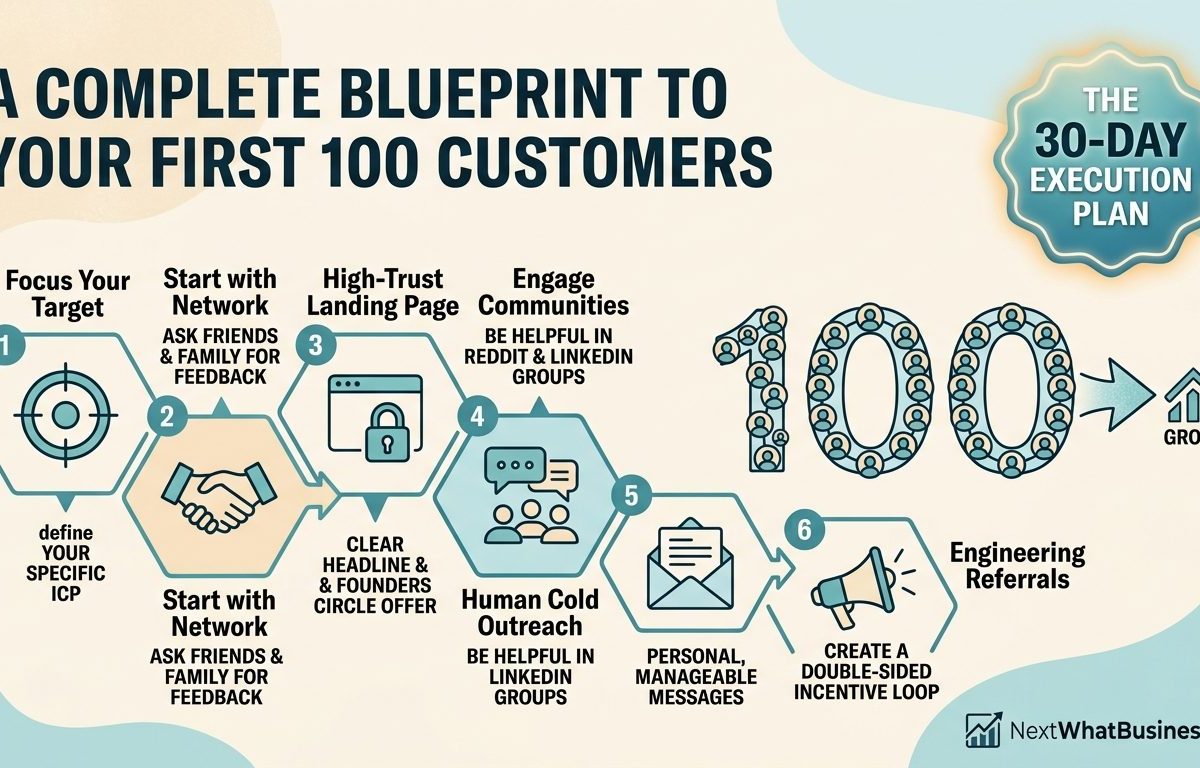
A 30-Day Execution Plan
| Week | Focus | Key Activity |
|---|---|---|
| Week 1 | Setup | Finalize your ICP, build your landing page, and list 100 “Dream” contacts. |
| Week 2 | Network | Reach out to your personal network for feedback and referrals. |
| Week 3 | Outreach | Join 5 communities, answer 10 questions daily, and send 10 personal DMs/day. |
| Week 4 | Referral | Launch your “Founders Circle” incentive and ask current users to invite one peer. |
Conclusion
Finding your first 100 customers may seem like a mountain, but it is completely achievable with a reader-centric approach. Stop writing for the search engines and start writing for the person on the other side of the screen.
Use simple language, provide a clear blueprint, and be the coach they didn’t know they needed. The tech and the tools are just the delivery mechanism—the real value is in the transformation you provide.
The most important step is simple: start today. Reach out to one person. Take action.

Rupak Chakrabarty is the Editor at NextWhatBusiness and a business strategy analyst with over two decades of hands-on experience advising small and mid-sized businesses. His work focuses on entrepreneurship, franchise models, business planning, and market behaviour, with an emphasis on practical decision-making over theory. When not writing or consulting, he enjoys adventure sports, speed, and exploring stories behind businesses.