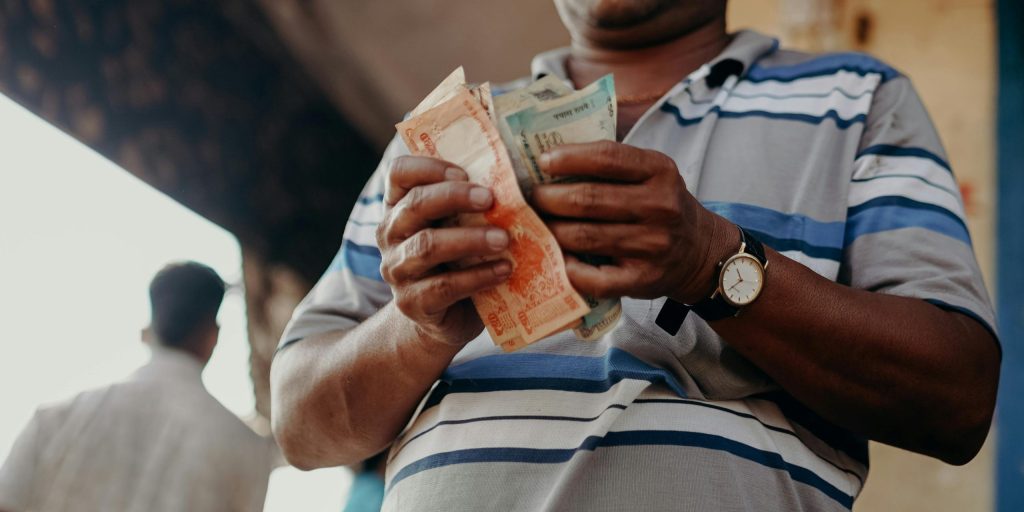
The Indian financial markets woke up to a bit of a jolt on December 3, 2025. For the first time ever, the Indian rupee breached the ₹90 mark against the U.S. dollar in early trade. It wasn’t a dramatic crash — it eased down by a few paise — but the moment itself carried weight. The currency slid to ₹90.02 per dollar in morning trade, after opening at around ₹89.96. And just like that, a psychological barrier that analysts and policy-watchers have been talking about for months… finally broke.
Some might say “it was only a matter of time,” and honestly, they’re not wrong. The pressure had been building steadily — rising dollar demand from banks, jittery foreign investors moving money out of Indian markets, and a global economic mood that’s, well, anything but cheerful. Put it all together and the slide doesn’t sound surprising. Expected or not, though, crossing 90 marks a significant moment for India’s economic narrative.
Table of Contents
A Look Back at How We Got Here
The warning signs didn’t appear overnight. The rupee had closed at a near-record low of ₹89.95 the previous day, and even during intraday trading, it flirted briefly with the ₹90 mark. Analysts had noted that as long as banks and corporates kept demanding dollars the way they have been — mostly for imports and forex settlements — the rupee would remain under pressure.
Read: Rupee Slide: Who Really Stands to Benefit?
Foreign investors haven’t helped either. Global capital tends to flow toward “safe places” in shaky economic environments, and recently, India has been more of an exit point than an entry point for them. Nervous hands selling equities and withdrawing funds leave behind a thinner capital cushion and a lot more pressure on the currency.
I spoke with a trader who’s been watching the forex market for two decades. His view? “Exporters still love a weak rupee, so this phase isn’t exactly hurting them. But import-heavy companies and anyone with dollar-denominated loans — this is not their happiest week.” And honestly, that statement pretty much sums up the immediate impact.
What This Means for India’s Economy
A weak rupee isn’t inherently “bad” or “good” — it depends on who you are. But for everyday people and most businesses in India, the downsides tend to feel sharper.
Imports Become Pricier
Fuel prices, electronics, industrial machinery, pharma raw materials — if something is imported, it’s going to cost more now. The effect might not show up today or tomorrow, but just wait a few weeks. Higher import costs play a silent game, gradually nudging up transportation, manufacturing and retail prices.
And yes… petrol and diesel will be the first thing many people think of.
Inflation Threat
Most economists don’t panic about inflation at every currency twitch. But this isn’t a twitch — this is a structural fall. When import costs rise, inflation tends to follow. For a population already dealing with high living expenses, that’s not great news.
Stock Market Mood Gets Complicated
Foreign institutional investors have been pulling out. That means lower liquidity. The markets don’t like uncertainty, and they definitely don’t like foreign capital fleeing. A weak rupee can also discourage fresh foreign investment — it makes India “look riskier,” whether that perception is fair or not.
On the flip side — and there is a flip side — exporters may now find themselves in a slightly happier position. Every U.S. dollar they earn translates into more rupees, so sectors like IT services, textiles, and pharma might actually enjoy stronger quarterly numbers if the trend holds.
Tourists and Foreign Students Feel the Burn
This one has no silver lining. Anyone paying for travel, tuition, or overseas medical bills in dollars will feel the pinch almost immediately. Families of students abroad are probably not loving the news this morning.
What Triggered the Rupee Drop — Really?
There’s never just one reason when a currency shifts, but some things clearly pushed the rupee downhill:
- Heavy dollar demand by banks and corporates
- Persistent capital outflows by foreign investors
- Uncertain global economic environment
- Volatile crude oil prices
- A generally strong U.S. dollar worldwide
- Limited intervention from policymakers in recent weeks
Some traders expected the Reserve Bank of India (RBI) to step in aggressively before the rupee crossed 90. But so far, the interventions have been measured and not enough to reverse the trend.
This could be a strategy — RBI has always said it doesn’t “fix” the rate, it only prevents disorderly volatility. A slow decline isn’t necessarily “disorderly.” Still, the crossing of ₹90 might force a more active stance in the coming days.
Is ₹91 Next? Or Will the Rupee Bounce Back?
That’s probably the question on every investor’s mind right now.
If crude oil prices jump or global markets remain shaky, a fall toward ₹91 or beyond isn’t out of the question. On the other hand, if foreign investors return, or if there’s strong RBI intervention, there could be a correction.
The truth? Nobody really knows. Currency markets are part economics, part sentiment, and part luck. What we can say with confidence is that volatility isn’t leaving anytime soon.
Final Thoughts
The rupee slipping past ₹90 per dollar is more than a headline. It’s a strong signal about where the economy stands — and how fragile global conditions still are. For businesses and households across India, the effects will ripple out over the coming months. Some sectors will win, many will hurt, and consumers are likely to feel the aftershocks in the form of higher prices.
Whether this is just a short-term rough patch or the beginning of a new pricing reality will depend heavily on foreign investment trends, oil prices, RBI strategy, and — frankly — global geopolitics.
For now, all eyes are on the currency market… and the 9:15 AM opening bell on Dalal Street.

NextWhatBusiness Research Desk represents the editorial research function at NextWhatBusiness.
Content published under the desk is based on independent research, operator-level observations, and analysis of small, medium, and franchise-led business models in India.
The focus is on practical decision-making — including capital requirements, operational effort, and risk factors — rather than promotional or brochure-driven information.
Some articles reflect editorial judgment based on observed patterns and may include opinionated analysis where appropriate.
Editorial oversight is provided by Rupak Chakrabarty, Editor, NextWhatBusiness.