
Treehouse Preschool Franchise — Complete Cost Breakdown, Profit & Application Guide
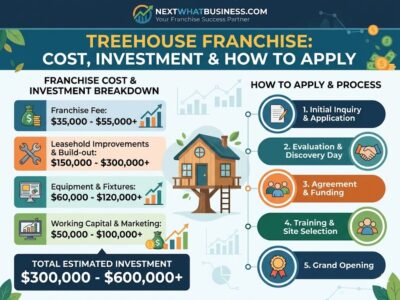
The Treehouse preschool franchise is India’s lowest-investment national preschool brand — started in 2003 in Mumbai by Treehouse Education Limited (listed on BSE and NSE), with a franchise entry point of ₹5–10 lakhs and a minimum space requirement of just 1,000 sq ft. Below is everything you need to evaluate and apply: complete cost breakdown, monthly operating costs, realistic profit estimates, eligibility criteria, and the step-by-step application process.
Want an honest review that explains the company’s 2016–2020 financial crisis, its current operational status, and who should not invest? Read our Treehouse franchise honest review →
Franchise at a Glance
Brand | Tree House Play School / Treehouse Education Limited |
Parent Company | Treehouse Education Limited — listed on BSE and NSE |
Founded | 2003 — Mumbai, Maharashtra |
Founder | Rajesh Bhatia |
BSE Scrip Code | 534774 (verify current status at bseindia.com before investing) |
Network | Self-operated and franchise centres across 33+ cities — verify the current active count with the company |
Distinction | The maximum number of self-operated preschools in India among national brands |
Age group served | 1.5–6 years (Playgroup, Nursery, Junior KG, Senior KG) |
Franchise model | FOFO — Franchise Owned, Franchise Operated |
Total investment range | ₹5–10 lakhs — lowest among national preschool franchise brands |
Royalty | Confirm exact rate in writing during application — not publicly disclosed |
Space required | Minimum 1,000 sq ft carpet area — ground floor with outdoor play area |
Break-even period | 12–24 months (location and enrollment dependent) |
Franchise agreement term | Confirm with the company — typically 3–5 years |
Geographic availability | Pan India — strongest recognition in Mumbai, Pune, and Western India |
Application | treehouseplaygroup.net/apply-online.php | treehouseplaygroup.net |
Key Differentiators vs Other National Preschool Franchises
Feature | Treehouse | Kidzee | Bachpan | EuroKids |
|---|---|---|---|---|
Total investment | ₹5–10 lakhs | ₹15–25 lakhs | ₹12–20 lakhs | ₹15–22 lakhs |
Min. space required | 1,000 sq ft | 2,000 sq ft | 2,000 sq ft | 1,500 sq ft |
Listed on the stock exchange | ✅ BSE + NSE | ✅ BSE + NSE (Zee Learn) | ❌ Private | ❌ Private (KKR-backed) |
Self-operated centre experience | ✅ Yes — runs own centres | ❌ Franchise-only model | ❌ Franchise-only model | ❌ Franchise-only model |
Geographic strength | Western India — Mumbai, Pune | Pan-India | North/Central India | South India + metros |
Network size (current) | Verify with the company — reduced from peak | 2,000+ | 1,200+ | 2,200+ |
Complete Cost Breakdown
Cost Head | Estimated Amount |
|---|---|
Franchise/startup fee — brand licence, curriculum access, initial training | ₹2–4 lakhs |
Interior fit-out — flooring, painting, child-safe furniture, classroom display | ₹1.5–3 lakhs |
Play equipment — indoor/outdoor age-appropriate structures and activity stations | ₹50,000–₹1 lakh |
Curriculum materials — initial teaching aids, workbooks, activity kits | ₹30,000–₹60,000 |
Technology — computer/tablet, basic display, CCTV setup | ₹30,000–₹70,000 |
Branding and signage — exterior board, classroom branding materials | ₹20,000–₹50,000 |
Security deposit (refundable — premises) | ₹30,000–₹1.5 lakhs |
Licensing — GST, FSSAI, fire safety NOC, municipal trade licence | ₹20,000–₹50,000 |
Pre-opening marketing — pamphlets, local outreach, digital promotion | ₹15,000–₹40,000 |
Working capital — 2–3 months operating costs before stable enrollment | ₹1.5–₹2.5 lakhs |
Total Estimated Investment | ₹6.65–14.7 lakhs |
Treehouse officially states ₹5–10 lakhs as the investment range, “including startup franchise fee and interior and equipment costs.” Property and rental costs are not included. Working capital is additional. Figures are indicative — verify current costs with Treehouse’s franchise team before committing.
Ongoing Monthly Operating Costs
Cost Head | Monthly Estimate | Notes |
|---|---|---|
Rent (1,000–1,500 sq ft, ground floor) | ₹6,000–₹35,000 | Treehouse’s small space requirement enables significantly lower rent than other national brands |
Staff salaries — teachers (2–4) + admin | ₹22,000–₹55,000 | Smaller centre capacity means a lower absolute staff count than Kidzee or EuroKids |
Royalty (rate to be confirmed in writing) | ₹6,000–₹22,500 | Estimated at 10–15% of ₹60,000–₹1.5 lakh monthly collection — verify exact rate |
Curriculum materials — monthly replenishment | ₹3,000–₹7,000 | Prescribed Treehouse materials — cannot be locally substituted |
Electricity and utilities | ₹2,500–₹7,000 | Lower than larger centres due to smaller space |
Local marketing (society outreach, social media) | ₹3,000–₹8,000 | Higher than average for Treehouse — local marketing carries more weight, given reduced national brand campaigns |
Misc — maintenance, cleaning, consumables | ₹1,500–₹3,500 | — |
Revenue Model — How a Treehouse Centre Earns
Revenue Source | Typical Amount | Frequency |
|---|---|---|
Annual admission/registration fee | ₹3,000–₹10,000 per child | Once per year per child — at enrollment |
Monthly tuition fee — Metro / Tier-1 | ₹2,500–₹4,500 per child | Monthly, 10–11 months per year |
Monthly tuition fee — Tier-2 city | ₹1,500–₹3,000 per child | Monthly, 10–11 months per year |
Monthly tuition fee — Tier-3 town | ₹1,000–₹2,000 per child | Monthly, 10–11 months per year |
Curriculum kit and material charges | ₹500–₹2,000 per child per term | Termly |
Summer camp/holiday programme | ₹2,000–₹5,000 per child | May and December — key seasonal revenue |
Extracurricular activities (optional) | ₹300–₹1,000 per child per month | Monthly optional add-ons |
Profit Estimates by Enrollment Level
Enrollment | Monthly Fee Income (avg ₹2,000/child) | Net Monthly Profit | Break-even Status |
|---|---|---|---|
20 students (early ramp-up) | ₹40,000 | Loss — ₹(5,000–20,000) | Not yet |
35 students | ₹70,000 | ₹5,000–₹20,000 | Near break-even |
50 students (break-even zone) | ₹1,00,000 | ₹20,000–₹38,000 | Crossing into profit |
75 students | ₹1,50,000 | ₹54,000–₹72,000 | Comfortably profitable |
100 students (near capacity for 1,000 sq ft) | ₹2,00,000 | ₹80,000–₹1,05,000 | Strong profitability |
Treehouse’s lower space requirement means a 1,000 sq ft centre is typically limited to 60–80 students across all programmes. For higher enrollment, a larger 1,500–2,000 sq ft premises is needed. May and December will show near-zero income — maintain 2–3 months’ working capital reserve.
City-Wise Investment Estimates
City / Region | Total Investment Estimate | Monthly Rent (1,200 sq ft) | Monthly Fee per Child |
|---|---|---|---|
Mumbai / Pune (brand’s home market) | ₹9–14 lakhs | ₹20,000–₹50,000 | ₹3,000–₹5,000 |
Delhi / NCR / Bangalore / Hyderabad | ₹8–13 lakhs | ₹15,000–₹40,000 | ₹2,500–₹4,500 |
Tier-2 cities | ₹6–10 lakhs | ₹8,000–₹20,000 | ₹1,500–₹3,000 |
Tier-3 towns and smaller markets | ₹5–8 lakhs | ₹4,000–₹12,000 | ₹1,000–₹2,000 |
Eligibility Criteria
- Investment capacity: ₹5–10 lakhs plus working capital of ₹1.5–₹2.5 lakhs — total readiness of ₹7–13 lakhs recommended
- Space: Minimum 1,000 sq ft carpet area on ground floor with an outdoor play area — owned or leased
- Location: Residential area with a young family demographic and no other national preschool brand within walking distance
- Prior experience: Not mandatory — Treehouse provides training; an education background is an advantage
- Commitment: Genuine passion for early childhood education; willingness to be personally present, especially in the first 2 years
- Geographic availability: Pan India — strongest in Western India markets where the brand has a historical presence
Support Provided by Treehouse
- Curriculum and academic programme: Structured preschool curriculum covering all age groups from Playgroup to Senior KG; lesson plans and teaching guides
- Staff training: Pre-opening training for franchisee and teaching staff on curriculum delivery, classroom management, and centre operations
- Infrastructure standards: Centre setup guidelines and ambience standards for a consistent Treehouse brand environment
- Branding and signage: Exterior board, classroom branding materials, and display standards
- Website listing: Franchisee centre details listed on Treehouse’s official website and in local advertisements (at the company’s discretion per official documentation)
- Ongoing academic support: Periodic academic guidance from Treehouse’s team — extent of current support should be confirmed in agreement
- Self-operated network insight: Treehouse’s unique advantage of running its own centres means operational best practices from real-world centre management inform the franchise support programme
Important: The extent and quality of ongoing support have changed significantly from Treehouse’s pre-2016 peak due to the company’s restructuring. Get specific, written commitments on all support deliverables — visit frequency, training schedule, marketing material supply, and academic programme updates — before signing the franchise agreement.
Pros and Cons
Strengths
- Lowest investment of any national preschool franchise — ₹5–10 lakhs makes preschool franchising accessible to investors who cannot afford Kidzee or EuroKids
- Smallest minimum space requirement — 1,000 sq ft enables operations in residential spaces where other brands cannot fit
- Listed on BSE and NSE, public financial disclosure provides transparency that private franchise companies cannot offer
- Only national preschool brand that also runs self-operated centres — real operational knowledge informs franchise support
- ET Award for fastest-emerging preschool in Western India — historic brand credibility
- Recession-resistant category — preschool education demand is structurally growing regardless of brand
- Very attractive unit economics at low investment — ₹54,000–₹89,000 net monthly at 75 students on ₹7–8 lakh investment
Risks
- Severe financial distress 2016–2020 — documented in BSE filings; stock fell from ₹180 to under ₹5; centres closed; franchisee support disrupted
- Current network is smaller than the pre-2016 peak — verify active centre count with the company directly
- Brand recognition outside Western India and historical markets is weaker than Kidzee, Bachpan, or EuroKids
- Franchisor support infrastructure has been scaled back from peak — get specific written commitments before signing
- Royalty structure not publicly disclosed — must be confirmed in writing
- Smaller absolute centre capacity (1,000 sq ft = 60–80 students max) limits income ceiling vs larger format brands
- Seasonal May/December cash flow gap — same as all preschool franchises; smaller absolute revenue makes the gap proportionally harder to absorb
How to Apply — Step by Step
- Review the company’s current BSE filing — search “Treehouse Education” at bseindia.com and read the latest annual report before proceeding. This is a listed company — its financial position is public; use this information
- Visit the official Treehouse franchise page at treehouseplaygroup.net/apply-online.php and fill out the online enquiry form
- Request current franchisee references — specifically ask for 2–3 franchisees who have opened in the last 2–3 years (post-restructuring); speak with them about current support quality
- Submit a detailed application — proposed location address, space dimensions, investment plan
- Location assessment — Treehouse evaluates your premises for space adequacy, safety, and location suitability
- Get all financial terms in writing — royalty rate, marketing fee, maintenance fee, specific support deliverables, and territorial exclusivity before any agreement discussion
- Review and sign franchise agreement — have the agreement reviewed by an independent lawyer; ensure all support commitments are written into the agreement as obligations, not assurances
- Pay franchise fee and begin setup — interior fit-out per Treehouse standards; typically takes 3–6 weeks for a 1,000 sq ft space
- Staff recruitment and training — hire teachers and complete Treehouse’s training programme before opening
- Regulatory approvals — apply for fire safety NOC, FSSAI, municipal trade licence in parallel with setup
- Pre-opening marketing — begin local admission outreach 6–8 weeks before opening; align with January–April admission season
Official Treehouse Franchise Contact:
Website: http://www.treehouseplaygroup.net
Registered Office: 702 ‘C’, Morya House, Off New Link Road, Near Infinity Mall, Andheri West, Mumbai — 400053
Documents Required
- Identity proof — Aadhaar card and PAN card
- Address proof
- Passport-size photographs
- Educational qualification certificate
- Property documents — lease agreement or sale deed; NOC from landlord if rented
- Bank statements demonstrating investment capacity
- GST registration (obtained post-approval)
- FSSAI food licence (post-approval if serving snacks)
- Fire safety NOC from local fire department (post-approval)
- Health and sanitation clearance from the municipal authority
- Shop and Establishment Act registration (post-approval)
- Signed franchise agreement with Treehouse Education Limited
Frequently Asked Questions
What is the investment for a Treehouse franchise?
₹5–10 lakhs total as officially stated by Treehouse — the lowest investment among national preschool franchise brands in India. This includes the startup franchise fee, interior fit-out, and equipment costs. Property rental and working capital are additional. In practice, budget ₹7–14 lakhs, including working capital reserves, to ensure a financially stable launch.
Is Treehouse Education financially stable?
Treehouse Education Limited is a listed company on BSE and NSE — you can verify its current financial position directly by checking the latest annual report and quarterly filings at bseindia.com (search “Treehouse Education”). The company underwent severe financial distress between 2016 and 2020 and has since restructured. Current financial health should be verified independently before investing — the listed company status gives you access to financial disclosures that private franchise companies do not provide.
What is the minimum space needed for a Treehouse franchise?
1,000 sq ft carpet area on the ground floor with an outdoor play area — the smallest minimum space requirement among national preschool franchise brands. This enables operations in residential building ground floors and smaller commercial spaces where Kidzee (2,000 sq ft) and EuroKids (1,500 sq ft) cannot operate.
How long does it take to break even on a Treehouse franchise?
At Tier-2 city fee levels (₹2,000/child/month), break-even is typically reached at 50 enrolled students, which takes approximately 12–18 months in a well-located centre with active admission marketing. The lower investment means break-even in terms of capital recovery can occur faster than higher-investment brands, even at the same enrollment level. Well-managed centres in good locations report break-even within 12–20 months.
How does Treehouse differ from other preschool franchises?
Three key differentiators: (1) Lowest investment — ₹5–10 lakhs vs ₹12–25 lakhs for competitors. (2) Smallest space requirement — 1,000 sq ft vs 2,000 sq ft for most competitors. (3) Only national preschool brand that also operates self-run centres — giving it real operational experience that franchise-only brands lack. The smaller current network offsets these advantages, reduces post-restructuring support infrastructure, and requires independent verification of current financial health.
Disclaimer: Investment figures and profit estimates are indicative, based on publicly available data including Treehouse’s official franchise portal, BSE regulatory filings, and published sources as of May 2026. Prospective investors are strongly encouraged to independently verify Treehouse Education Limited’s current financial position at bseindia.com before committing to a franchise agreement. Verify all current franchise terms directly with Treehouse’s official franchise team. NextWhatBusiness does not receive commission from this listing.